
*This post may contain affiliate links for which I earn commissions.*
Manifestation is often talked about as “raising your vibration” or “taking aligned action,” but in practice, it’s usually much simpler than that. It looks like managing your time, your attention, your sleep, and your emotional capacity well enough that you can keep showing up for what actually matters to you.
If you’ve ever started a goal feeling genuinely excited, only to stall out a few weeks later, it’s not because you lack willpower or some kind of spiritual worthiness. More often, you’ve just been overspending your energy. Energy behaves a lot like money—it has limits, patterns, and consequences.
This is where an energy budget becomes useful. When you start treating your energy as something to allocate, your manifestation practice becomes steadier, less harsh, and far more sustainable. Instead of pushing until you burn out, you begin working with your real capacity.
Understanding Your Energy Budget

At its core, an energy budget is simple: you have a finite amount of usable capacity each day and week. Some things replenish it, some drain it, and some do both. The key is being honest about what your “yes” actually costs.
It also helps to recognize that energy isn’t just physical. It shows up in different layers of your life:
- Body energy: sleep, nutrition, chronic pain, hormones, movement
- Mental energy: focus, problem-solving, decision fatigue
- Emotional energy: grief, stress, social overwhelm, mood swings
- Spiritual energy: meaning, trust, inner coherence, nervous system safety
When these layers are ignored, effort tends to come in bursts. You push hard, then crash, then question why nothing is working. But when you start paying attention to your capacity, the process changes. It becomes less about forcing results and more about staying in a steady relationship with what you’re building.
That shift matters. A goal isn’t just something you want—it’s something you’re in an ongoing relationship with. And like any relationship, it needs pacing.
A Quick Self-Check
A simple way to check in with yourself is to notice your patterns without judging them.
- When do you usually feel clear and capable during the week?
- When do you feel foggy, irritable, or stretched thin?
- What keeps draining you even though you try to ignore it?
- What actually restores you that you keep putting off?
The point isn’t to become perfectly efficient. It’s to understand your own rhythm so you stop planning your life as if you were someone else.
Aligning Goals With Capacity
This becomes especially important when you think about “aligned action.” It doesn’t mean constant action, but rather action that fits both your values and your actual capacity.
A common pattern that leads to burnout is setting goals that quietly require more energy than you can consistently give, then trying to make up the difference with intensity. It often looks like building an overly ambitious routine, relying on motivation instead of structure, treating rest like something you have to earn, or assuming exhaustion is a personal failure.
An energy-based approach flips that. Instead of forcing yourself to match the goal, you shape the goal around your capacity.
The Three-Layer Goal
Try viewing your goal in three layers:
- The Vision: the long-term outcome (the “north star”)
- The System: the repeating support (habits, schedule, environment)
- The Next Small Step: one specific action you can do without strain
Most people stay focused on the vision, which is understandable. But sustainability lives in the system, and momentum comes from the next small step.
For example, if your goal is to build a daily creative practice:
- Vision: “I want art-making to be part of my life again.”
- System: “I keep a sketchbook open on the table, and I do 10 minutes after tea.”
- Next Small Step: “Tonight, I will choose one pen and draw three slow lines.”
The step can feel almost too small to matter, but it’s often what builds consistency. It teaches your nervous system that the process is safe to return to. And consistency, over time, creates trust.
A Useful Question: What Is The Minimum That Still Counts?
A helpful question to come back to is: what is the smallest version of this that still counts? Not as a way of lowering your standards, but as a way of avoiding the all-or-nothing cycle. A minimum can act as an entry point instead of a compromise.
Energy Leaks, Energy Investments, And The Myth Of Unlimited Output
Burnout often comes from energy that’s being spent in ways you don’t fully notice. Some drains are obvious, like long work hours or caregiving. Others are more subtle, such as trying to remember too many things at once, or spending hours on your phone feeling stressed afterwards.
In communities focused on positive thinking and manifestation, these problems sometimes get labelled as “bad mindset.” People might tell you to think more positively. But what you really need is to stop or reduce the things that empty your energy tank.
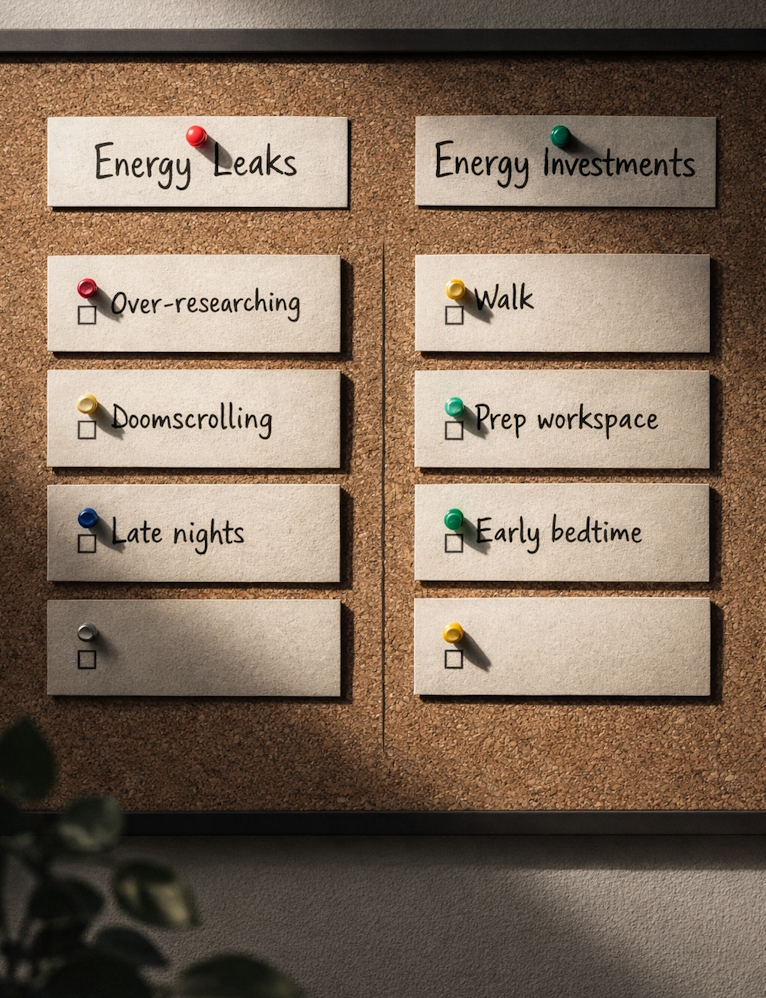
It can be useful to sort your activities into two groups: energy leaks and energy investments.
Energy Leaks
Energy leaks are the things that cost you but don’t meaningfully support your wellbeing or your goal. Saying yes out of guilt, researching instead of starting, constantly reworking your plan, or comparing your pace to someone else’s highlight reel all fall into this category.
Energy Investments
Energy investments, on the other hand, are the things that consistently give something back. A short walk that clears your head, preparing your workspace so it’s easier to begin, setting a boundary that protects your time, or doing a weekly check-in that keeps your expectations realistic—these are all small actions that improve your capacity over time.
The deeper skill here is discernment. It’s not just about what you want—it’s about what you continue to feed with your time and energy.
A Simple Reframe
Instead of asking whether you have enough motivation, it can be more useful to ask whether you have enough energy for the version of the plan you’ve created. And if not, what version would actually fit today? What would make it easier to begin?
Ease isn’t the same as laziness. In many cases, it’s a sign that you’re working with yourself instead of against yourself.
Symbols And Structure: A Calm Spiritual Frame
If you like having a light symbolic layer to your practice, you can think of your energy budget as a kind of container. A container has edges. It doesn’t try to hold everything—it holds what matters, and it does so with intention.
You might choose a simple symbol to represent that idea. A circle can stand for both wholeness and limits. A bowl can represent holding and receiving. A lantern can suggest steady guidance. A key can symbolize permission. A mountain can remind you of pacing.
Nothing elaborate is needed. The point is just to have a quiet reminder that your energy has edges, and those edges are protective.
A Small Ritual That Is Not A Performance
Once a week, take 3 minutes and do this:
- Look at your calendar.
- Identify one commitment you can soften, shorten, or delay.
- Name one support you will add (earlier bedtime, a slower morning, a simple meal plan).
- Write your symbol at the top of the page as a reminder of the container.
It’s not dramatic, but it’s effective. This is what manifestation looks like when it’s grounded in maintenance.
Practical Application Or Creative Exercise: The Energy Budget Map
This is a short, adaptable exercise you can do with a notebook, a printable planner, or even notes on your phone. It takes 5 to 10 minutes.
Step 1: Pick One Goal For The Next 14 Days
Pick one goal to focus on for the next two weeks—just one, not several—and write it down in a single clear sentence.
Step 2: Draw Three Columns
Label them:
- Energy Leaks
- Energy Investments
- Minimum Aligned Action
Now fill them in.
Energy Leaks: List three current drains that are affecting you – be as honest and specific as you can.
Energy Investments: Then list three things that help restore or support your energy.
Minimum Aligned Action: Finally, define the smallest action you can take consistently that still feels meaningful.
Examples of minimum aligned actions:
- 5 minutes of journalling
- One page of reading
- Sending one email instead of five
- Ten steady breaths before starting work
- Tidying one surface so your space feels usable
Step 3: Choose A Weekly Budget Number
After that, choose a number from one to ten to represent your realistic capacity for the week.
- 1 to 3: survival week, keep it tiny
- 4 to 6: steady week, small consistent progress
- 7 to 10: spacious week, you can add a little stretch
Then adjust your plan to match that number. If your capacity is a four, don’t design a plan that requires an eight.
Reflective Prompts
Use one or two of these prompts to deepen the exercise:
- “What part of my plan is based on who I wish I was, rather than who I am right now?”
- “Where am I treating rest as something to earn?”
- “What would it look like to pursue this goal with greater care?”
- “What boundary would support this goal without making my life rigid?”
A Helpful Resource Suggestion

If you enjoy structure, an energy budget printable can be genuinely useful, especially one with weekly check-ins and space for “minimum aligned action”. A simple manifestation journal also helps when it includes space to track your capacity, your drains, your supports, and your minimum actions.
The goal is not to become perfectly organised – It’s to make your goal easier to carry.
Closing Thoughts: Sustainable Manifestation Is Quiet And Real
Sustainable manifestation isn’t about doing less forever. It’s about doing what you can continue.
When you respect your capacity, your effort becomes more consistent and less tangled in pressure or exhaustion. Your intention feels clearer. Your nervous system settles. And the goal starts to integrate into your life instead of competing with it.
A useful idea to hold onto is this: the most effective form of manifestation is often the one you can repeat without harm. Your pace is part of the process.
Reflective Takeaway:
Choose one small action that fits your energy today, and let that be enough. Consistency even when it’s quiet, still counts.