*This post may contain affiliate links for which I earn commissions.*
When your brain feels too busy and loud, grounding exercises might seem like another task on your to-do list. You might think you need a silent space, special items like candles or crystals or that you need to feel calm before you even start.
That’s not true.
What actually helps is finding something that fits into your regular day, right when you need it. You don’t have to wait for perfect conditions or step away from your life to make it work.
Grounding is just a way of coming back to what’s present when your thoughts have run ahead of you. It doesn’t need time, space, or a perfect setup. It can take five minutes, and it can start with whatever is already within reach.
In this post, you’ll find simple grounding rituals built around ordinary things already on your table, desk, bedside, kitchen counter, or wherever your keys end up. You don’t need to prepare anything. You just need a place to begin.
The Table As An Anchor, Not A Stage
Most grounding advice sounds like you need to create a moment.
You don’t. You can use one that already exists.
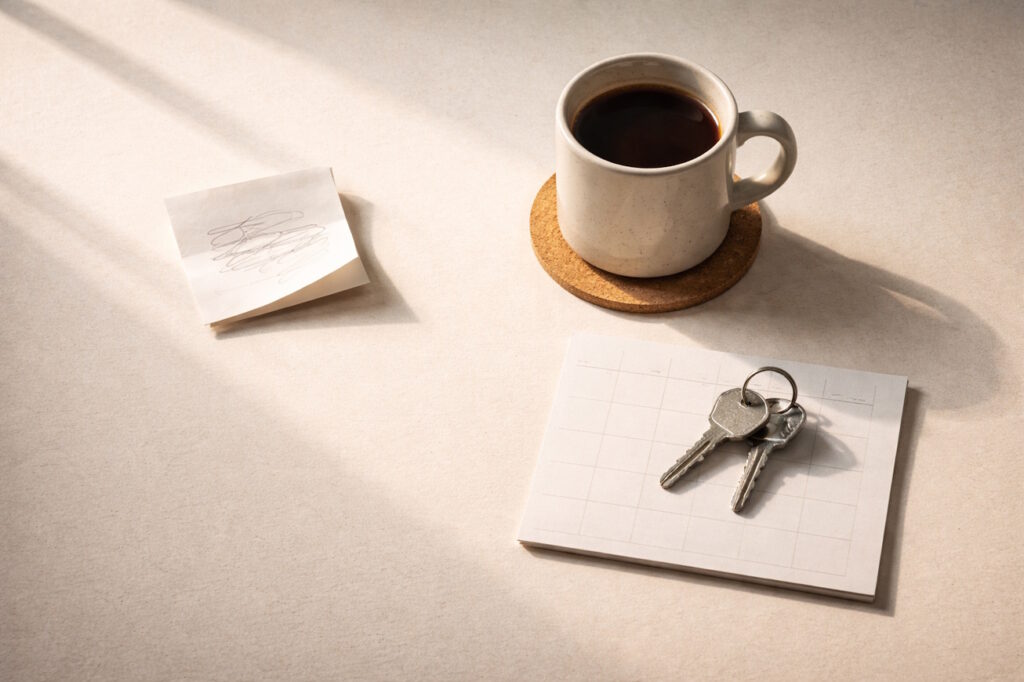
A table works well because it already does one simple thing: it holds things steady. And when your mind doesn’t feel steady, that matters more than it sounds.
Think of your table as an anchor point for your nervous system. Not an altar or a performance, just a place that quietly reminds you: I’m here. I’m safe enough. I can choose what happens next.
Look at what’s already there.
- A mug or glass: warmth, weight, hydration, and a reason to slow your breathing.
- A notebook, receipts, or a post-it pad: somewhere to put words to the reality of your situation.
- Keys, coins, or a ring: texture, temperature, and a reminder that today is happening right now.
- A phone: not for scrolling, but as a boundary (five minutes, then stop).
- A plant, a piece of fruit, or a spoon: shape, colour, something real your attention can land on.
You don’t need to feel calm for this to work.
You just need to feel a little more real than you did a minute ago.
That’s enough to start.
Reflective prompt:
- What does “grounded” actually feel like in your body, even slightly? Heavier shoulders? Slower breathing? Less pressure behind your eyes?
The Five-Sense Reset With One Ordinary Object
If your mind is spiralling, don’t try to think your way out of it.
Give it something to do instead.
Sensation is immediate. It pulls you back faster than analysis ever will.
Pick one object already near you. A pen. A teaspoon. A paperclip. Anything small and physical.
Then move through this:
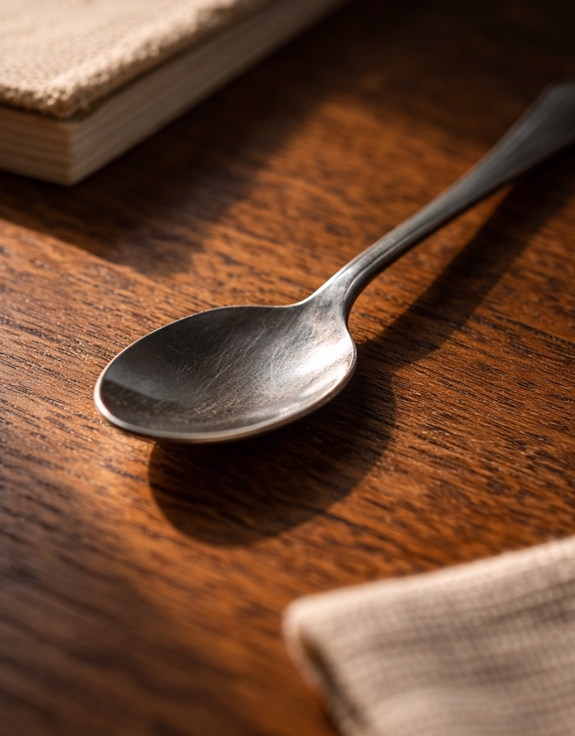
- Sight: Look at it properly. Shape, edges, colour, light, shadow.
- Touch: Hold it. Notice weight, texture, temperature, the pressure in your fingers.
- Sound: Tap it gently. What do you hear, soft, dull, sharp?
- Smell: Bring it closer. Even if there’s no scent, notice that.
- Breath: Take three slow breaths without looking away.
This works because it interrupts the loop. Your attention has somewhere specific to go.
If you want to add intention, keep it simple and believable:
- “I choose steadiness in the next hour.”
- “I return to what matters.”
- “I can meet this moment with care.”
Nothing dramatic. Just something you can actually hold onto.
Reflective prompt:
- Which sense brings you back the fastest, sight, touch, sound, smell, or breath?
Sorting What’s On The Table Into Meaning
When everything feels a bit tangled, clarity often comes from making things visible.
Your table can help with that.
Look at what’s in front of you and choose three items:
- One that represents what’s pulling at you (a bill, an open tab, a to-do list).
- One that represents support (a mug, a jumper, a book, a plant).
- One that represents direction (a pen, a calendar, your keys).
Place them in a small triangle, or line them up from left to right: pressure, support, direction.
Then pause, just for one minute, and name them:
- “This is what’s asking for my energy.”
- “This is what helps me.”
- “This is the next right step.”
This is where things shift.
Because instead of everything feeling vague and heavy, it becomes something you can see, and respond to.
If you want to take it one step further:
- Choose one small next step that fits into the next 24 hours.
- Attach it to your “direction” object.
Keys → one errand.
Pen → one email.
Keep it small enough that you’ll actually do it.
Reflective prompt:
- Which is usually missing when your days feel off, pressure, support, or direction?
Micro-Rituals With Water, Paper, And Light
If you’re not sure where to start, start here.
These are things you already have. And they work because they bring you back into your body quickly.
Water: The Two-Sip Return
This takes less than a minute.
- Take one slow breath.
- Take two deliberate sips.
- After each sip, ask: “What do I notice right now?”
That’s it.
Warmth. Taste. Swallow. Maybe your shoulders drop slightly.
Small shifts count more than you think.
Optional intention:
- “I let my body arrive before my mind rushes ahead.”
Paper: The Three-Line Truth
When your thoughts feel messy, make them smaller.
Take any piece of paper and write:
- What I’m feeling
- What I need
- What I can do next
Example:
- “I feel overstretched and scattered.”
- “I need a simpler plan.”
- “I can choose one priority.”
You’re not solving everything.
You’re just getting out of the fog.
Light: The Soft Focus Minute
If everything feels too fast, slow your breathing slightly.
- Inhale for 4
- Exhale for 6
- Repeat for 5 breaths
Look at a lamp or window while you do it. Let your eyes soften.
Longer exhales can help your body settle, even if your thoughts are still busy.
That’s enough.
Reflective prompt:
- When you feel untethered, what helps most, water, words, or light?
Practical Application Or Creative Exercise
The “Table Sigil” Five-Minute Practice
If you want something slightly more intentional, this is a simple way to do it without overcomplicating things.
What you need: a pen and a small piece of paper.
- Choose a simple intention for the next few hours.
- “steady focus”
- “gentle confidence”
- “one step at a time”
- Write it once. Circle the word that stands out.
- Turn that word into a simple symbol.
- underline it
- stack the letters
- or draw a few shapes that represent it
- Place the paper under something you’ll touch again (your mug, keys, mouse).
- Each time you touch it, take one breath and remember the intention.
No pressure to feel different.
Just a quiet return, repeated.
If you like structure, a simple printable or small journal can help. Not because you need it, but because it makes the habit easier to come back to.
Optional journalling prompt:
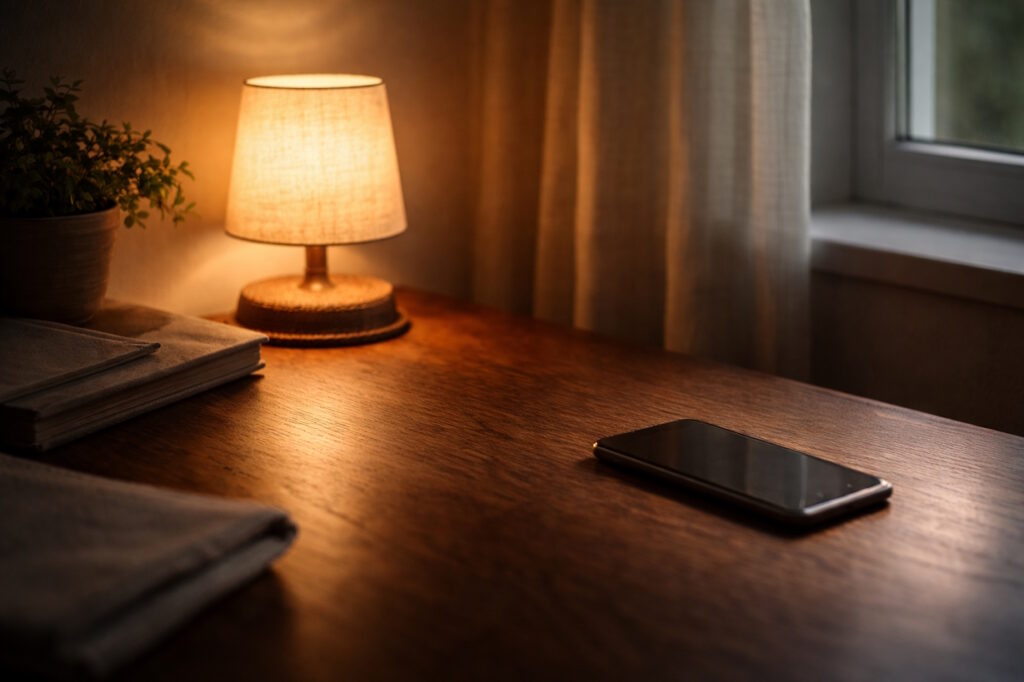
If your table was an anchor point for your day, what would you place there on purpose, and what would you remove?
Closing Thoughts
You don’t need ideal conditions to ground yourself.
You need something simple enough that you’ll actually use it.
That’s why this works. Your table is already part of your life. You’re not adding something new, you’re just using what’s already there differently.
And that’s often what makes the difference.
Five minutes. One object. One small shift in attention.
That’s enough to change the tone of a moment.
And sometimes, that’s all you need to change the direction of a day.