
*This post may contain affiliate links for which I earn commissions.*
Manifestation can feel elusive in everyday life. You set your intention, feel hopeful for a moment, and then the week moves on. Meetings, errands, messages, laundry, and all the other things that demand your attention, the intention is still there, but keeping it in focus becomes more and more difficult.
The One-Object Manifestation Ritual offers a simple method to maintain focus without pushing yourself to think positively all the time. You select one everyday item & assign it a specific meaning. Then you use it as a consistent reminder for one intention over seven days.
In this post, you’ll learn how to pick the right object, how to assign meaning in a grounded way, and how to work with it throughout the week using simple touchpoints. No dramatic ceremonies required, just a small practice that keeps your attention returning to what matters.
Choose An Object That Fits Your Real Life
The best object is not necessarily the most “spiritual” one, but rather the one you will actually notice and touch during your normal week. Think practical first, symbolic second.
A helpful hint, is to choose something that matches your intention in texture and “feel.” For example If you want calm, pick something smooth and weighty, if you want momentum, choose something light that moves easily, and If you want consistency, choose something durable.
Here are a few good options, with what they naturally lend themselves to:
- Key: access, permission, opening, boundaries
- Coin: value, exchange, worth, receiving, saving
- Ribbon or thread: connection, continuity, devotion, patience
- Stone: steadiness, grounding, protection, simplicity
- Button: repair, readiness, small progress, holding things together
- Paperclip: organisation, focus, keeping things aligned
- Tea bag tag: pause, nourishment, daily ritual
- Pen: clarity, voice, decision-making, commitment
Reflective prompts for choosing:

- When in my day would I realistically notice this object?
- Does it feel neutral or supportive in my hand?
- Would it be easy to carry, wear, or place somewhere visible?
Assign Meaning With Clarity, Not Pressure
This ritual works best when meaning is simple and specific. You are not trying to convince the universe, you are training your attention.
Start by writing one intention in plain language. Keep it small enough to hold without strain.
Examples of grounded weekly intentions:
- “I respond instead of reacting.”
- “I make space for my creative work.”
- “I speak clearly about what I need.”
- “I take steady steps towards financial stability.”
- “I treat my body with more kindness.”
Then connect the intention to the object with one sentence that feels genuine rather than overstated.
Examples:
- Key: “This key reminds me that I can choose what I let in and what I keep out.”
- Coin: “This coin reminds me to receive support and to value my time.”
- Ribbon: “This ribbon reminds me to stay connected to my intention, even when the day gets busy.”
- Stone: “This stone reminds me to find my balance again.”
If you like a slightly more creative layer, choose a colour that fits the intention. Use a green ribbon when you focus on growth or a blue stone when you seek calm. A copper coin works well for energy & warmth. Trust your instincts and keep things simple. Symbolism helps most when it makes you feel more connected to the moment rather than like you are putting on a show.
Place The Object Where It Can Do Its Job
The object only becomes an anchor when it reliably meets you in daily life. “Out of sight, out of mind” is very real, so you want to design for visibility and touch.
Try one of these placements:
- In your pocket (best for tactile reminders)
- On your keys (best for habits around leaving and returning home)
- On your desk (best for focus, study, creative work)
- By the kettle or coffee jar (best for calm, routines, wellbeing)
- On your bedside table (best for self-talk, sleep, morning steadiness)
- Tied to a journal or planner (best for reflection and follow-through)
If you live with other people and want to keep it private, you can tuck the object somewhere only you reach, like inside a pencil case, wallet, or the pocket of a bag you use daily.
A small but important note is worth mentioning here. Keep the ritual kind in your approach. If you happen to miss a day the object should not become a scolding tool. Think of it instead as a return point. Every time you notice it again you simply begin again.
Work With It All Week Using Micro-Moments
This is where the ritual becomes quietly powerful, you do not need long visualisations, just repeated contact.
Choose one or two small moments that you can realistically maintain. Each moment takes 10 to 30 seconds.
Here are a few simple options:
Morning Touchpoint
Hold the object and name the intention once.
- “Today, I practise calm responses.”
- “Today, I make space for my creative work.”
If you want a little extra structure, pair it with one breath in and one breath out. That’s enough.
Midday Reset
When you’re feeling disorganised and unfocused, touch the object and ask:
- “What does my intention look like in the next 10 minutes?”
This keeps it practical, turning manifestation into the next kind choice, the next clear action, the next small boundary.
Evening Review
Before bed, touch the object and note one moment you returned to your intention, even if it was tiny.
- “I paused before replying.”
- “I opened my notebook.”
- “I ate something that actually helped.”
That’s it. No moral scorekeeping.
If you prefer to keep written notes, a simple one-line log works beautifully. This is where a small journal, a notes app, or a printable “7-day intention tracker” can help, not because you need to be perfect, but because it gives your mind a place to put the story of the week.
Practical Application: The Seven-Day Anchor Card
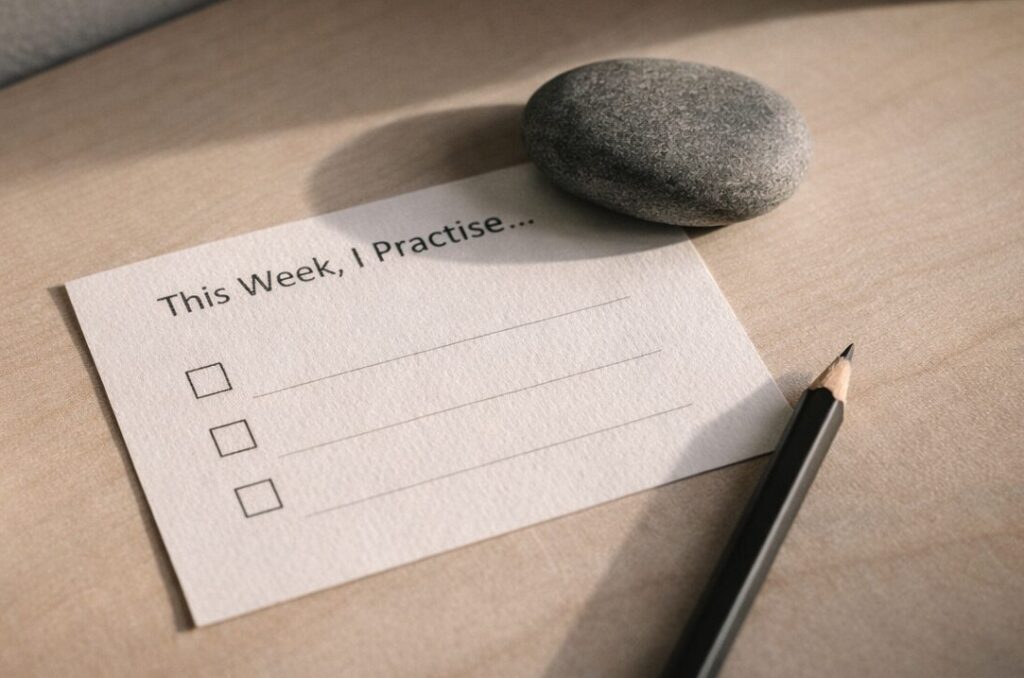
If you want a quick creative exercise that makes the ritual feel complete, try this. It takes five minutes and uses whatever you have on hand.
What you need:
- A small piece of paper or index card
- A pen
- Your chosen object
Steps:
- At the top of the card, write: “This Week, I Practice…”
- Fill in your intention in one sentence.
- Under it, write: “When I touch my object, I return to…” and finish that sentence.
- Write one supportive “if-then” line, such as:
- “If I feel rushed, then I take one breath.”
- “If I feel doubtful, then I do the next small step.”
- Place the card where you will see it, or tuck it into a journal.
Optional creative layer: add a small symbol in the corner that matches the intention, like a circle for steadiness, a wave for flexibility, a star for guidance, a spiral for growth. Keep it minimal. The point is recognition, not decoration.
If you enjoy guided structure, this is one of those practices that pairs nicely with a simple printable, like a weekly intention card set or a small art prompt pack built around everyday symbols. It helps because you are not starting from scratch each time, and you can build your own library of meanings that feel personal and consistent.
A Closing Thought To Carry Forward
The One-Object Manifestation Ritual is not about controlling outcomes, but rather creating a relationship with your intention, one you return to in ordinary moments. Over a week, that steady returning can close the gap between what you want and how you live.

Choose an object that fits your real days. Give it a meaning that feels honest. Then let it remind you, quietly and repeatedly, that you are allowed to begin again as many times as you need.