*This post may contain affiliate links for which I earn commissions.*
Creating a mindful home doesn’t have to begin with big renovations or expensive décor, often the most meaningful shifts arise from the little things we choose to place in our everyday environment, especially the images that greet us every day on our walls. A symbolic gallery can quietly shape the tone of a room, offering moments of focus, calm, and reflection throughout the day.
Mindful wall art doesn’t need to be elaborate – with printables you can curate a collection that feels personal, intentional, and spiritually grounded without the pressure of searching for rare or costly pieces. You can easily create your own symbolic gallery that supports mindfulness or manifestation practices, bringing deeper meaning into your space, using accessible artwork you can print at home.
Choosing Symbols That Reflect Your Inner Landscape
The heart of a symbolic gallery is not the aesthetic itself but rather the intention behind each piece. Before gathering your images, take time to consider what qualities you want your space to reflect. Calmness? Clarity? Creativity? To start, choose one central thought or feeling for your gallery. A single word – like clarity, flow, or presence – can create a clear thread connecting each artwork which makes it easier to select symbols and images that complement one another.
Select simple, resonant symbols
Symbols become powerful not through complexity but through association. You may feel drawn to geometric motifs for example – circles representing wholeness and unity, triangles symbolising direction and focus, or lines and pathways for journeys, choices, or transitions.
Others may prefer natural imagery – mountains for strength, rivers for surrender, seeds for growth etc. Your entire gallery could even be built around just one of these ideas, allowing the symbol to unfold through different colours or styles.
Keep emotional tone in mind
If you enjoy guided reflection, a gentle resource like a mindfulness journal can help clarify your themes before you choose any art. Writing a few lines can help reveal what visual symbols you’re truly seeking. Allow your emotional compass to filter out artwork that is visually appealing but not aligned with your intention, ask yourself: How do I want to feel when I look at this wall?
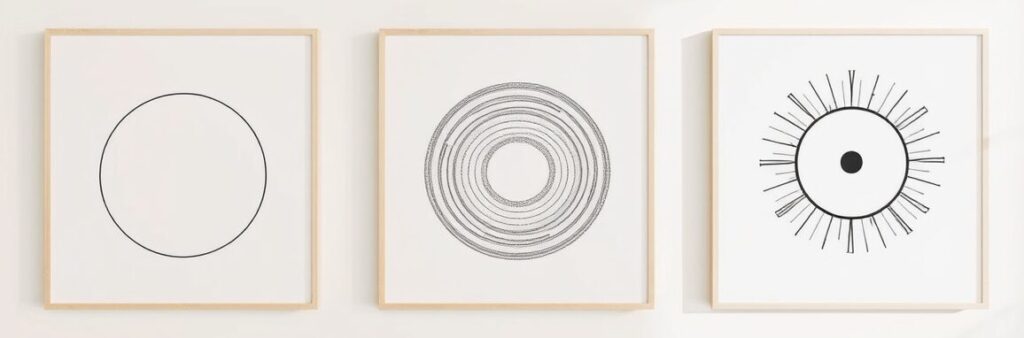
Repeating a shape or symbol throughout your gallery creates a quiet rhythm, for example three different circular designs can create continuity without uniformity.
Once you’ve chosen your symbols, the next step is to shape how they interact with each other on the wall. Even a handful of printables can form a pleasingly articulate narrative when placed with care. Limiting the palette can help diverse images feel more connected – you might feel drawn to warm earth tones for grounding, soft neutrals for calm, or muted blues and greens for clarity.
Play with repetition
Repeating a shape or symbol throughout your gallery creates a quiet rhythm, for example three different circular designs (one minimal, one textured, one symbolic) can create continuity without uniformity. This kind of visual phrasing mirrors the process of meditation itself, repeatedly returning to a familiar point of focus.
Give your gallery room to breathe – instead of filling every inch of the wall, try spacing your printables with intention. An empty space can act as a pause, giving your eyes time to rest and your mind space to wander.
Mix literal and abstract
A meaningful gallery often blends the symbolic with the atmospheric. A simple geometric sigil next to a soft watercolour wash, or a botanical line drawing beside a mantra, adds depth without visual noise. Abstract art can hold the emotional tone of your theme, while more symbolic images can provide a conceptual anchor.
If you prefer pre-curated sets, printable art bundles, especially those designed around mindfulness or manifestation, can offer an accessible start while still allowing room for personal expression.
Using Art as a Mindfulness Tool
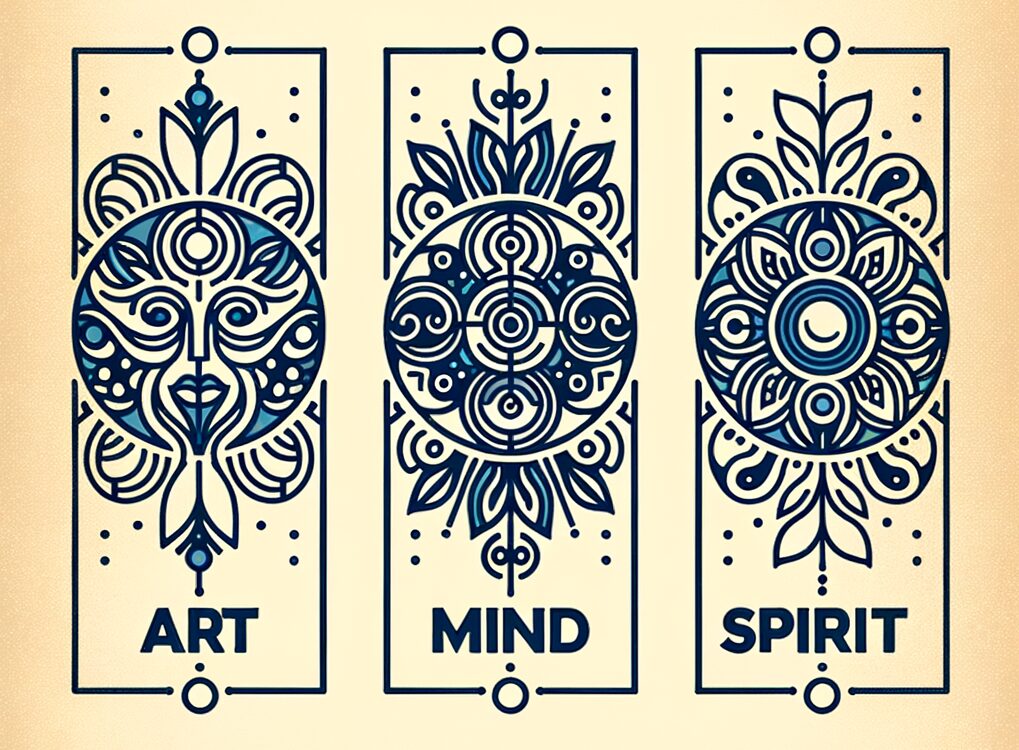
Mindful wall art isn’t just decoration; it’s a companion to quiet practices and daily rituals which when chosen thoughtfully, becomes part of your pathway to growth. Symbols positioned near your workspace or meditation area can act as prompts – a rising sun motif may remind you to pause and take a slow breath, a doorway symbol in your hallway might encourage you to walk through your day with intention.
For those of us exploring visualisation practices, an abstract or symbolic gallery can help to shift your state of mind before beginning. If you use tools like guided journaling sheets or manifestation prompt cards, displaying complementary art nearby can deepen the sense of focus and continuity.
Artwork representing gratitude could rest beside a small dish in which you place an item you’re grateful for each evening. An image symbolising clarity might enhance a corner where you keep your favourite journal or a guided manifestation notebook.
Seasonal rotation
In the ever-changing journey of life, our personal spaces should mirror the dynamic nature of our paths. A thoughtfully curated gallery, updated regularly, reflects our evolving aspirations and energies. By using printables, we can easily refresh our surroundings without spending a fortune or putting in too much effort. This resource-friendly approach lets us honour the ups and downs of our moods and goals, making sure our environment truly represents us. As we grow and change, so does our gallery, showcasing the fluidity of our dreams and desires.
Practical Exercise: A Gentle Gallery-Making Ritual
If you’d like to ground your creative process, try this small reflective practice:
- Settle into the room where you plan to display your gallery. Notice how the space feels right now — its light, energy, and quiet corners.
- Write down three words that describe how you want this space to support you (e.g. calm, clarity, renewal).
- Choose one symbol that resonates with those words. It can be simple: a circle, leaf, wave, doorway, star etc.
- Find or create two or three printables featuring versions of that symbol in different styles or colours.
- Lay them on the floor in front of the wall to explore spacing and flow. Move them around until something feels quietly “right.”
- Hang them with lightness — don’t worry about perfect alignment. Let your gallery feel lived in, not rigid.
This small exercise turns the act of decorating into a moment of intention-setting.


Conclusion
A mindful gallery doesn’t have to be elaborate. With a few symbolic printables and a clear intention, you can shape a wall that quietly steadies your focus and gently supports your inner work. As you curate your images, let your instincts guide you – choose what feels honest, arrange what feels balanced, and allow the space to evolve. Small moments of creativity often lead to the most meaningful shifts; ‘The beauty lies not in perfection but in presence’.